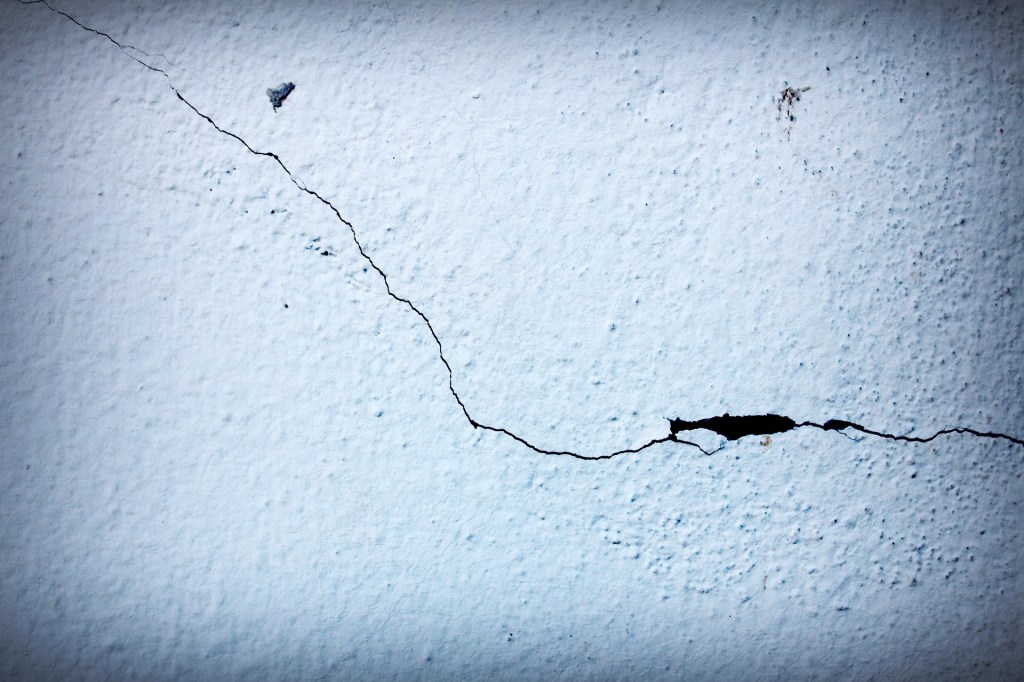
There are cracks in the plaster. Sometimes I stop, and stare, and fret over them. The carpenter says not to worry, the house has good bones, it won’t fall. But I see the cracks, long and jagged, like a tiger raked its claws across flesh and left behind wounds that leak the house’s life. It’s normal, contractors say. Old houses wear and weather and tremble and groan. They get a few stretch marks, a few scars. The structural engineer says there’s no need for him to come. It’s just cracks, not an imminent risk of collapse.
Just cracks.
So we patch and conceal and hide them, pretending they were never there. Out of sight, out of everyone’s mind except mine. When I run my fingers over the fresh paint, I can still feel them, faintly, leaving behind a ridge like a scabbed-over scrape. I wonder at the cause, the root behind the symptom, and ask without answer if it will continue to worsen, if there’s a hidden disease that will eat through studs and joists and beams like cancer through skin and organs and bones until the ceilings crumble and the walls buckle like weary knees, until it’s too late, the whole structure beyond repair.
All because we dismissed the cracks in the plaster.
Small moments can make big memories. One such small moment flitted past, hummingbird-quick, thirteen years ago. At the time, the exchange lasted seconds. But it has hovered in the peripheral vision of my memory, causing me to glance sidelong at it, time and again.
Photo by Adina Voicu
In the Arboretum
He plunges his nose into a lilac cluster and inhales, drinking the scent into his lungs the way a marathoner gulps water a dozen miles into the race, as if the dainty petals’ perfume is the sustenance of life.
He catches my gaze and quirks a brow. “Yeah, I stop to smell flowers. So what?” he says, words a soft-tipped arrow fired from a smile’s bow. He doesn’t realize he owes no explanation to me,
Because while he admires the flower, I admire his attention to the bloom.
Two volumes on my summer reading list included Good Poems, American Places compiled by Garrison Keillor, and Amanda Lovelace’s collection The Witch Doesn’t Burn in This One. Both books have inspired me to dabble in poetry again.
As always, I can’t promise my poetry is any good. But there’s joy in the writing.
A flock of blackbirds billowed over a rural stretch of Route 23. Starlings, or grackles maybe, thousands of black pixels against a blue canvas of sky, shaping into a half-formed image before dissolving like a dream escaping waking’s grasp.
I pulled my car to the shoulder to watch them dance to the metronome of my hazard lights, searching for meaning in their pattern as they swooped, ascended, condensed, separated. Eventually they blended into the tree line, and I wondered if maybe
the meaning was never in the pattern, but only in the flight.
It’s been a while since I dabbled in poetry. But the mood struck this morning, and this one flowed out.
The Grade School Rule
In grade school, teachers always told us to use pencils. “Ink is too permanent,” they would warn. “Use your pencil. Especially for math and spelling.” They expected mistakes that we would have to remove, and they didn’t want us to ruin the page.
Life doesn’t listen to the teachers’ advice. We are handed a pen at birth to start scrawling our stories. Sometimes, maybe, a chapter can be salvaged by scribbling out errant words. But the blemish on the page – an ugly dark slash of ink – remains, unable to be erased.
For several months, I’ve been laying the foundation for the magic system and its lore in The Witch’s Witness, my novel-in-progress about a coven of Vermont witches and the mysterious (and potentially dangerous) stranger who appears in their backyard.
Every time I’m developing a new fictional culture and its inhabitants, my radar starts blipping for worldbuilding in other media. For every page I turn or episode I view, there’s a persistent whisper in my mind: What stands out about this fictional world? What are the creators doing right in this media? How can their method instruct my own work?
My most recent Netflix marathon featured the platform’s two seasons of Altered Carbon, based on Richard Morgan’s 2002 cyberpunk novel of the same name (which I unfortunately haven’t read, yet). In the Altered Carbon universe, technology has advanced so the human consciousness can be stored in a cortical stack, which is an electronic device installed in the spinal column. If the body dies, the mind can live on and be installed into a new body, or “sleeve.”
The concept of human immortality and the exploration of its impact, limitations, and morality is enough to make the story compelling.
But what immediately reeled me into the world was the lingo.
There’s plenty of lingo I can point to. The “stacks,” which store the human mind and are installed in bodies; “RD,” or real death, if a person’s stack gets destroyed; “sleeves,” or bodies in which stacks are installed (and “resleeving” when a person is loaded into a new body); “Meths,” a term based on an abbreviation of the 969-year-old Biblical figure Methuselah, which is used to refer to the wealthy elite who can afford to continuously resleeve and essentially live forever.
On their own, each of these concepts is a solid piece of worldbuilding, but the language of the world elevates these concepts and makes them feel significantly more real. It’s a more immersive experience for the viewer (and/or reader) when we slip among characters who casually and dismissively make references to unique aspects of their universe. They accept all of this as a fact of life in their world; in turn, it helps viewers accept it.
I am infinitely impressed by other creators’ worldbuilding. My hope is to follow in their footsteps and create a believable world in which readers can immerse themselves.
Creating a magical reality
There’s a tricky balance to worldbuilding. On the one hand, I want to establish a setting where the characters accept the way the world functions without overly pondering it. After all, someone doesn’t have to know how gravity works to know that it works. It’s just a universal law. A fact of life.
On the other hand, I don’t want to create a magic system that is too vague – or, God forbid, has contradictions or plot holes. Nothing is scarier than the idea of a reader screeching to halt and saying, “Whoa, whoa, wait a minute. There’s no way that works.”
In The Witch’s Witness, the system of magic has a religious-like lore behind it. There’s an existing mythology about the source of witches’ magic (or the “wellspring,” as it’s known in text).
Magic isn’t widely known or practiced in this parallel version of Vermont. Covens keep a low profile after centuries of European and American witch hunts; they’re more than happy to let the masses believe magic is nothing more than a figment of imagination.
Except, of course, it’s real.
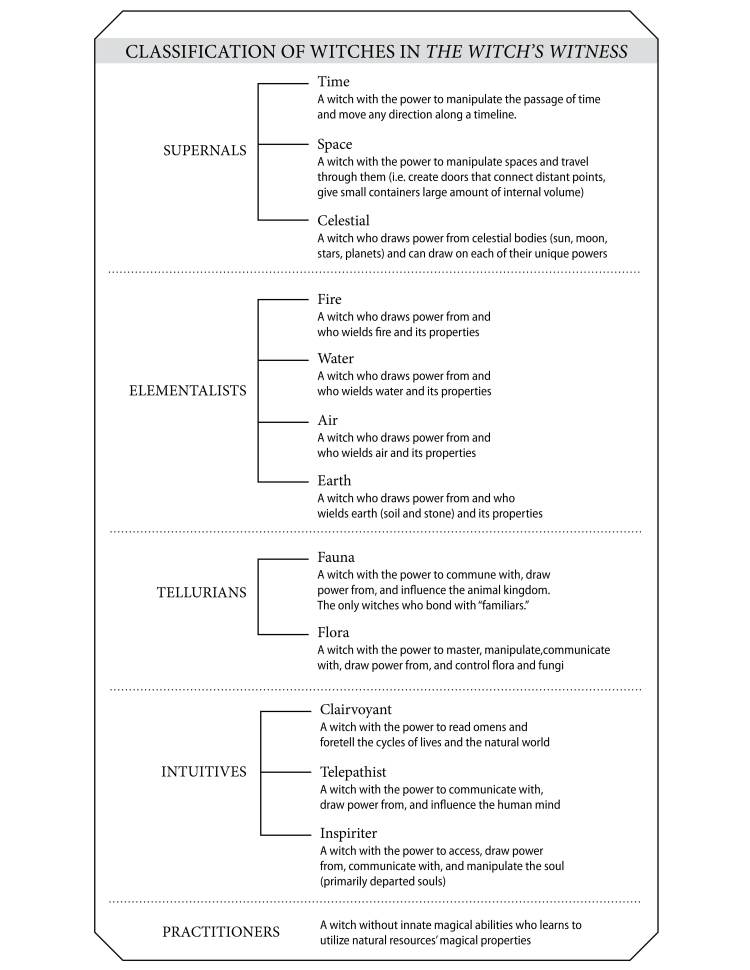
Witches can either be born with magic (an “innate talent”) or they can learn it as “practitioners.” Witches with an innate talent have an internal source of magic, whereas practitioners have to use external sources of magic, such as natural ingredients or artifacts.
As for the innate talents themselves: A witch can be born with an aptitude in one of twelve branches of magic. [See chart below]
Main character Heather Barlow is a flora witch who wields influence over the plant kingdom. She has a natural connection to the magical properties of plants and can draw upon their power to enhance her own. While other witches can use plants as tools in their magical practice, she can directly manipulate, communicate with, and control flora.
Any witch can practice the basics of another witch’s innate talent. A flora witch can use tea leaves to see shadows of the future, while a clairvoyant witch would have the natural ability to see visions without the aid of tea leaves. A practitioner can conduct a seance with symbols and tools to communicate with the dead, while an inspiriter has a direct connection with souls and can summon them without ceremony.
However, there are some skills that only a witch with an innate talent can yield. Summoning “hellfire,” for example. (Note: There is no hell, but it’s the name given to a form of fire that can be summoned from the spirit realm as the sole means to permanently destroy souls.) Only fire elementalists and inspiriters can summon it because fire witches have an innate link to flames and inspiriters have an innate link to the spirit realm.
The trick now is weaving these types of magic around each other and trying not to tangle any of them … or leave a gaping logic-hole in the tapestry of the story.
Have any thoughts, suggestions, or questions about the magic system in The Witch’s Witness? Feel free to share them in the comments below.
The calendar is one of those pesky little details that matters in fiction.
If a writer says Christmas Day is on a Friday, then New Year’s Eve better fall on a Thursday. Or if a full moon occurs in one scene, it better not be a clear moonless night the next week. Otherwise, a reader will inevitably catch the discrepancy.
When outlining The Witch’s Witness, I started plotting around the 2020. The calendar featured an uncommon Halloween convergence: a full moon and the end of daylight saving time. The “fall back” of the clock (marking the end of daylight saving time) at 2 a.m. on November 1 essentially added a thirteenth hour to Halloween night.
That thirteenth hour paired with a full moon was too significant to pass up in a novel about modern Vermont witches. As the outline evolved, those two details became pivotal to the story’s climax.
And then 2020 … well, it happened.
All evidence points to the story taking place in 2020, but there’s an enormous 50-ton purple elephant lurking in the margins, waiting for someone to notice it.
There’s zero mention of the COVID-19 pandemic.
Initially, I tried to pin down a different calendar year that could still fit the major plot points. The most important element was preserving the details about Halloween, so I started by hunting down years when daylight saving time falls on November 1. From 2010 to 2050, that only happens six times (2015, 2020, 2026, 2037, 2043, and 2048).
None of those Halloweens align with full moons – in fact, a Halloween full moon only happens once every nineteen years. The Farmers’ Almanac reports only six occurrences in this century (2001, 2020, 2039, 2058, 2077, and 2096).
With my plot firmly stuck in 2020, I started to worry about that 50-ton purple elephant trampling over the authenticity of my story. What happens if an astute reader points out the calendar that aligns with my plot?
Members of my writers’ group were quick to point out that there are witches and a system of magic in my novel’s fictional Vermont community, so the lack of COVID-19 doesn’t require much more suspension of disbelief. (Or so I hope.)
But the pandemic creates a unique challenge for modern fiction. Not all major historical events have to have an impact on a story’s plot – I could arguably write a book set in 2001 and not include details about 9/11 (unless the book is set in New York City, Washington D.C., or Somerset County in Pennsylvania). Even though 9/11 created an emotional response on an emotional level, it didn’t change most people’s day-to-day lives in the weeks to follow.
The pandemic, on the other hand, continues to have a daily impact on people’s lives. For novels that don’t have the wiggle room of fantasy and magic, it’s difficult to ignore how COVID-19 has altered daily routines. Masks in the grocery store, canceled high school sports seasons, mortality rates, the changed workplace landscape, the impact of isolation …
The more removed we get from the early days of the pandemic, the easier it will be to weave those details into the background while the main story takes the foreground. But for realistic fiction set in 2020, the pandemic is an immutable truth. Even if it’s not the main focus of the story, it’s a fixed part of the setting.
In the alternate Vermont where The Witch’s Witness takes place, I can only hope the magic system is strong enough to make readers believe in a world where the pandemic never happened.


 J. Elizabeth Stroebel